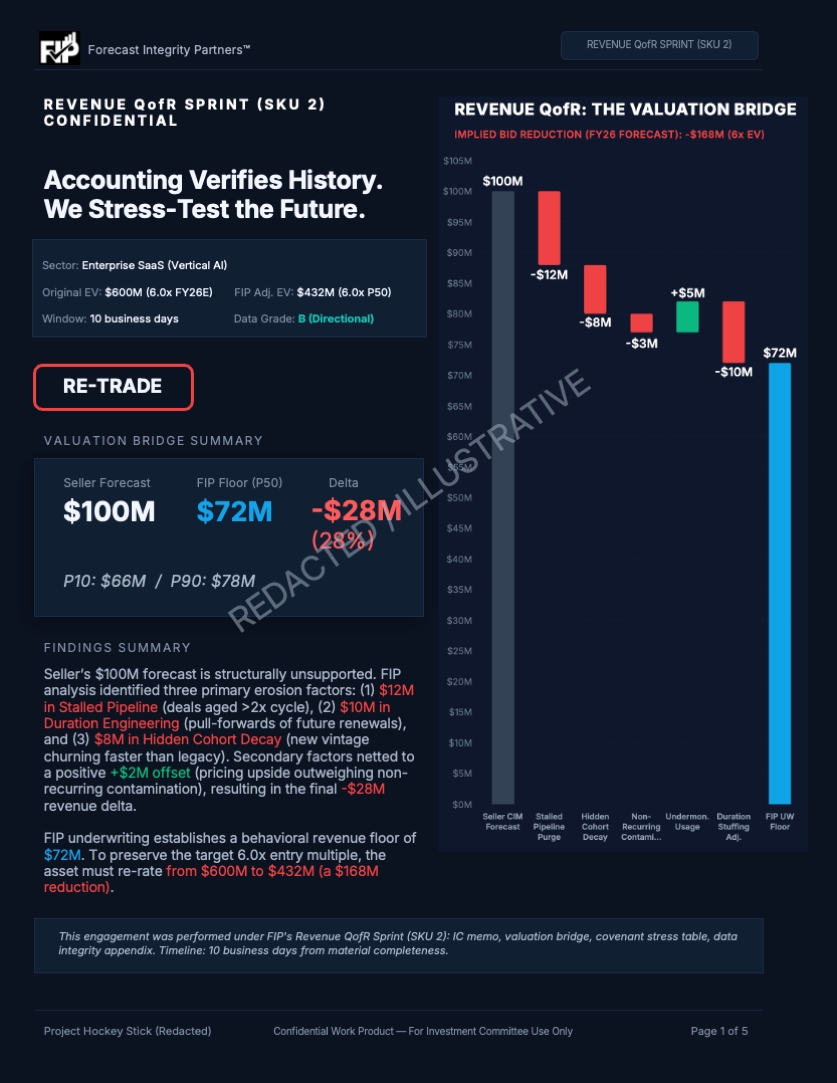
Real examples where the Challenger Model identified valuation air-gaps before the funds were wired.
Review the complete 5-page "Project Hockey Stick" artifact, including Covenant Stress Test and Deal Protections.
Scenario: Seller projected $100M ARR to justify 6.0x EV ($600M). Q4 bookings spiked.
Q4 "growth" was synthetic—achieved by pulling forward 3 years of renewals via heavy discounting. Normalized new logo acquisition had actually declined 15% YoY.
Outcome: Purchase price reduced by $130M. Deal closed with $30M earnout structure.
Scenario: Client evaluating acquisition of a product line projected to grow 20% YoY.
Internal models used rep-reported probabilities. Triangulation revealed a structural decline in Stage 2 conversion rates over 18 months, masked by "whale" deals.
Outcome: Validated downside case. Client adjusted bid by $120M. Offer accepted.
Scenario: Target reported 95% blended gross retention.
Cohort analysis revealed legacy customers retained at 98%, but recent cohorts (last 18 mos) retained at only 72%. The blended metric masked structural rot.
Outcome: Remodeled forward ARR revealed a $25M revenue hole. Buyer repriced the deal.
Scenario: Lender asked for covenant stress test on "recurring" revenue base.
Decomposition revealed 22% of "recurring" revenue was one-time implementation fees. True recurring base was flat.
Outcome: Lender reset covenant thresholds and added revenue composition covenants.