01 / ACQUISITION
Invest in better customers.
Compare acquisition channels by expected long-term contribution, not just first orders or cost per signup.
Build customer profitability into every decision.
I build forecasts around your products, acquisition channels, customer cohorts, and long-term behavior. Already have LTV or churn models? I can test their reliability and business usefulness before recommending new work. Your company owns the agreed models, code, and documentation.
Stephen McDaniel developed Netflix's original customer lifetime value models.
Expected contribution profit per customer, after acquisition cost, over 24 months
The cheapest signup isn't necessarily the most profitable customer.
Fictitious values to illustrate the decision, not company or client results.
Today's sale tells you little about a customer's future. Model how different customers behave over time, then use that evidence to guide the decisions that affect margin.
Compare acquisition channels by expected long-term contribution, not just first orders or cost per signup.
Identify customers with promising upgrade patterns and test which offers increase contribution.
Look for behavioral signals before customers cancel, then test the right time to intervene.
Estimate which saves are worth pursuing instead of offering concessions to everyone who leaves.
The system follows your customer journey, pricing, product line, and economic definitions. Your team can run the forecasts, inspect the assumptions, and improve the models without a required FIP platform subscription.
You pay for the expertise to build it. You keep the asset.
We establish the economics, verify the data, and prove the forecasting method before adding complexity. We don't build a black box and ask your team to trust it.
Agree on the target, time horizon, customer segments, profitability definition, and what a useful forecast must change.
Assess transaction, channel, subscription, and behavioral data. Identify gaps and misleading signals before modeling.
Estimate customer value, compare cohorts, quantify uncertainty, and backtest predictions against later outcomes. Add advanced modules when the data supports them.
Deliver the agreed outputs, code, documentation, and walkthrough. Monitor accuracy and test interventions as optional follow-on work.
I've spent decades building and teaching customer analytics, including the original LTV modeling work at Netflix.
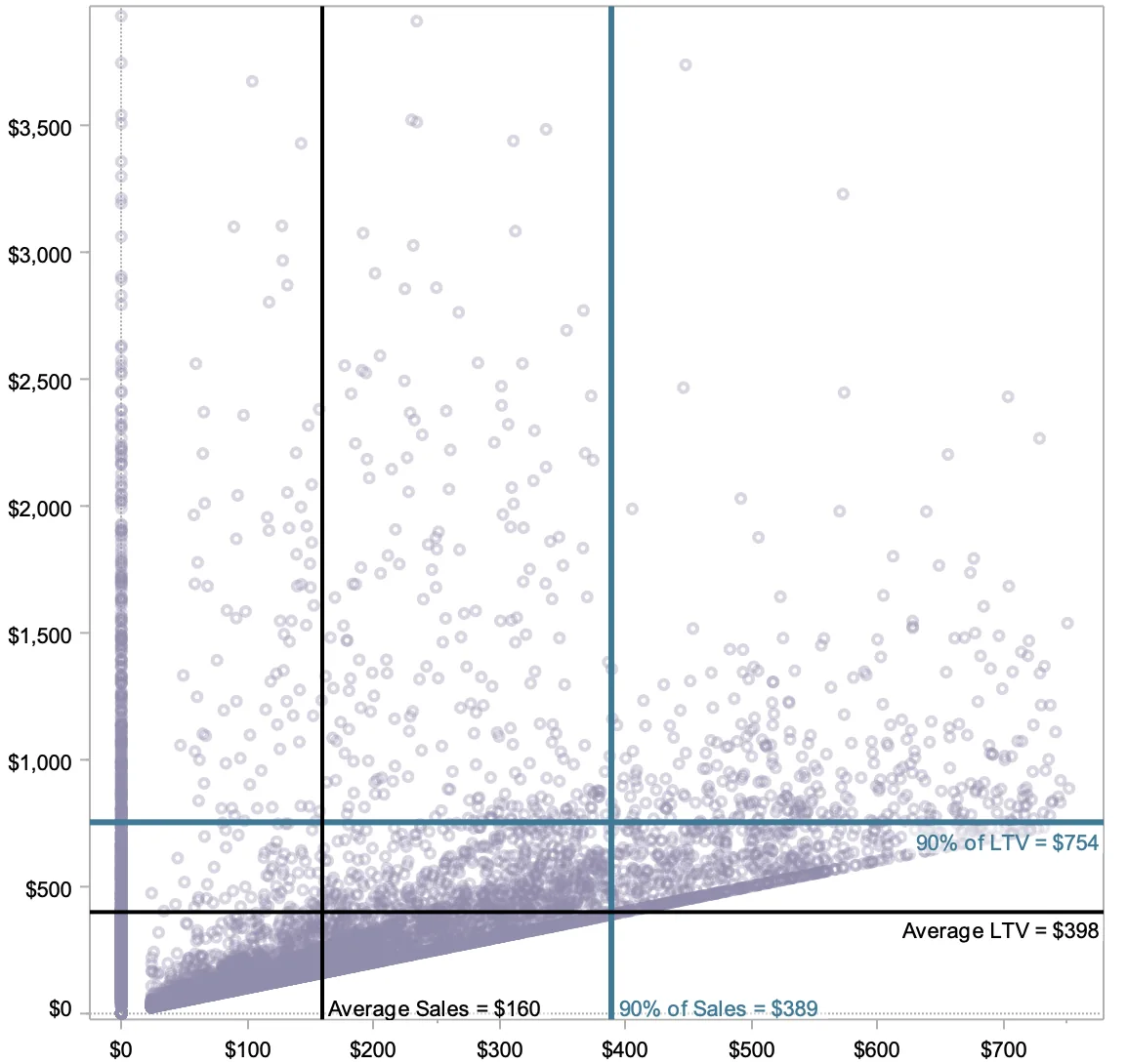
In a Tableau-published 2009 customer analytics case study, we combined customer segmentation with lifetime value estimates to expose differences hidden by averages. The same economic questions still matter: Who is valuable? How do you know? Where should you invest?
The historical paper credits Eileen McDaniel as author and Stephen McDaniel as contributor. Client values in the case study were modified for confidentiality.
My ideal engagement partner has at least $20 million in annual revenue, meaningful customer history, and leadership willing to change decisions when the evidence warrants it.
Recurring customer relationships. Subscription services, memberships, or recurring products with enough history to see behavior over time.
Usable data. Customer-level transactions, subscription events, acquisition sources, and ideally engagement activity.
A clear business owner. A CEO, CFO, or growth leader who can connect the forecasts to actual decisions.
Not the right fit yet? If you're earlier-stage or want to build your first model yourself, start with the Customer Lifetime Value Lab.
Your models may be sophisticated. The question is whether they predict realized customer value well enough to improve acquisition, upsell, and retention decisions.
Start with an independent, scoped review of your current models. If they are sound, keep them. If they need work, get a clear list of corrections. Ongoing monitoring is available without an FIP rebuild.
Explore model validationContribution margin, cohort definitions, channel attribution, and forecast targets.
Backtests, calibration, drift, and where uncertainty changes the decision.
Which acquisition, expansion, and retention choices might improve, and what evidence is still missing.
No replacement platform required. Readiness, security, validation scope, and data access are agreed before work begins.
I'm not selling you a software license and handing the work to someone you've never met.
I built Netflix's original customer lifetime value models and have spent more than 30 years helping organizations analyze data, forecast outcomes, and make decisions. I start with the business question, show my reasoning, and challenge the forecast before anyone relies on it.
You'll know what I'm building, why it matters, and what your team needs to maintain it.
Start with a specific customer economics decision. Get direct advice, build a system with your team, or have FIP build and transfer the agreed solution. Every engagement has a defined scope.
For a specific question or an internal team that wants ongoing critical review.
Two working hours on one defined question, together or in two one-hour sessions. Lab alumni: $995. Credit the public fee toward a $15K Diagnostic signed within 30 days, subject to the combined credit cap below.
One scoped existing model: intake and evidence review, a two-hour working discussion, and a concise two-page findings memo identifying risks, recommended checks, and next decisions. Not a full Diagnostic. Credit the fee toward a $15K Diagnostic signed within 30 days of the memo, subject to the credit terms below.
Up to three advisory and model-review hours per month, with a quarterly forecast-performance scorecard. Additional approved time: $750/hour. Your team prepares data, writes code, and operates the models; hands-on maintenance is separate.
First verify the economic opportunity. Then choose expert-guided or fully delivered implementation.
Approximately 20 FIP delivery hours. Assess data readiness, current model quality (if applicable), cohort LTV and channel economics. Receive a decision-ready readout: prioritized risks, channel-level opportunity estimates with stated assumptions and uncertainty, and a scoped business case for next steps. Timing starts when agreed data is ready.
Six weeks, approximately 25 FIP advisory hours. Your internal team implements the agreed baseline cohort LTV and channel-economics work while I guide, challenge, and validate. Advanced predictive modules are separately scoped.
Optional, scoped extensions for early churn, upgrade propensity, or retention-offer economics. Each requires appropriate history, acceptance criteria, and additional delivery time.
FIP designs, implements, backtests, documents, and transfers your company-owned customer-profitability forecasting system. The initial scoped build typically includes approximately 95 FIP delivery hours. Products, acquisition channels, data sources, integrations, validation criteria, deliverables, and handoff are defined in the statement of work. Advanced modules and ongoing monitoring are separately scoped.
Forecast performance changes as your products, channels, and customer behavior evolve. Monitoring is available for qualified existing models, including models not built by FIP.
Approximately eight hours monthly for agreed model refresh, backtesting, drift checks, and recommendations, with a quarterly executive-ready performance readout. Starts after a paid baseline review and agreed readiness assessment; models need not have been built by FIP.
Client ownership remains intact. Monitoring is optional, separately contracted, and never required to use your models. No mandatory FIP software subscription.
Each build agreement specifies the applicable data, model outputs, historical backtests, validation and reproducibility checks, documentation, review process, and handoff. Acceptance is based on agreed tests and deliverables, not promised business results.
Your team receives the agreed code, models, and documentation. Operate the system yourselves or contract for optional $8,000/month Hands-On Monitoring after readiness review. Monitoring is not bundled or automatically renewed with a build.
Published fees assume the scopes above and a signed statement of work. One entry credit per company applies toward a $15K Diagnostic signed within 30 days: the $1,500 public Consultation fee, the $2,500 Written Model Review fee, or $2,500 of a Corporate Team Pass (counted from the end of the Lab cohort). A completed $15K Diagnostic may receive up to $5,000 credit toward a Guided or Custom Build signed within 30 days of the readout. All consultation and Diagnostic credits toward a build are capped at $5,000 combined; credits have no cash value. Scope, acceptance criteria, access, IP ownership, monitoring service levels, and overages are agreed in writing. Custom Build pricing starts at $95,000 for the defined initial scope, with advanced modules, integrations, and monitoring separately scoped. Online booking and payment open soon.
Yes, for the deliverables defined in our agreement: typically your custom models, project code, forecasting logic, and documentation. Any third-party licenses or pre-existing reusable tools are specified separately. Your business keeps the agreed asset without a required FIP software subscription.
Usually. The first step is understanding your warehouse, CRM, billing data, and security requirements. I prefer to deliver into the tools you already use rather than introduce a new platform without a reason.
No blanket transfer is required. We can design a secure access arrangement or use data within your controlled environment, depending on project requirements. We'll agree on data handling before work begins.
Not necessarily. Customer value forecasting forms the foundation. We prioritize additional models based on the decisions at stake and whether your data can support reliable predictions. We test which interventions actually improve outcomes rather than treating a risk score as proof.
No. The Guided Build covers the defined baseline LTV and channel-economics scope with your team's implementation. Advanced predictive modules are optional, start at $12,000 each, and require appropriate data and separate acceptance criteria.
You do not need a rebuild. Start with a $2,500 written review of one scoped model or a $15,000 Diagnostic for broader economics, backtests, data readiness, and a decision-ready action plan. The review fee credits toward a Diagnostic signed within 30 days. Qualified existing models may proceed to hands-on monitoring after baseline validation, whether or not FIP originally built them.
In the $35K Guided Build, your internal team implements the agreed baseline cohort LTV and channel-economics models while FIP advises, reviews, and validates. In the Custom Build starting at $95K, FIP designs, implements, backtests, documents, and transfers the agreed system. Both require suitable data and a written statement of work. Advanced predictive modules are separately scoped.
Before work starts, the statement of work defines the data inputs, outputs, historical backtest approach, feasible validation criteria, reproducibility checks, documentation, and handoff requirements. Acceptance evaluates those agreed deliverables and tests, not a guarantee of future profitability or perfect prediction.
No. You receive and own the agreed system, code, and documentation and may operate it with your own team. Hands-On Monitoring is an optional, separately contracted $8,000/month service after a readiness assessment; it is not required, preselected, or included in the Custom Build price.
The $7,500 quarterly retainer includes up to three advisory and model-review hours per month plus a quarterly forecast-performance scorecard. Additional approved time is $750/hour. Your team handles code, data preparation, and operations. Separate $8,000 monthly monitoring covers hands-on work only within an agreed written scope.
It depends on data quality, number of products, integrations, and forecasting scope. A Diagnostic is planned around a readout within 15 business days after the complete agreed data is available, where the scope permits; build milestones are agreed in writing after data readiness is understood.
Ready to choose? Compare the options and pricing
Six foundational lessons and a synthetic-data workbook are being released during the initial rollout. Join the list to get each one as it is published, and to see cohort dates before enrollment opens.