
What executive decision depends on the number?
Q1 paid proof
Analytics Debt Ledger
A fixed-scope review of one dashboard, metric family, forecast, SQL workflow, reporting process, or AI-assisted number before executives rely on it.
$12,500 fixed scope. Delivered within 10 business days after artifact receipt.
Why it exists
Executives act from dashboards, forecasts, and AI summaries that nobody has independently tested.
The Ledger is the fastest way to prove whether a high-stakes number is safe enough for the decision attached to it. It does not turn into implementation, a dashboard rebuild, or free technical advisory.
The review translates metric, dashboard, SQL, workflow, forecast, and AI defects into cost, risk, false confidence, and executive decision exposure.
Best fit
- Board reporting risk
- Metric or KPI dispute
- Forecast miss
- Revenue, churn, ARR, CAC, LTV, margin, or pipeline logic concern
- AI summary or automation built on unverified reporting
- Cautious buyer who needs paid proof before a larger review
Fit call boundary
The fit call is not a free diagnostic.
The initial fit call confirms whether the Ledger is the smallest useful paid next step.
Dashboard, metric, SQL, model, forecast, workflow, AI output, or board package.
Board cycle, forecast miss, budget cycle, deal window, planning cycle, or cost pressure.
Who owns the pain, budget, artifacts, and next decision?
Whether one constrained Ledger can answer the question.
Whether the outcome points to stop, govern, rebuild, review, diligence, or retainer.
Diagnostic artifact example
What the review turns into executive language.
A useful review does not bury the lead. It names the artifact, defect, severity, and financial recommendation in plain language.
| Artifact | Discovered Error | Severity | Financial Recommendation |
|---|---|---|---|
| ARR dashboard joined CRM opportunity records to subscription records at mixed account and contract grain. | Expansion revenue was counted once at opportunity close and again when the renewed subscription became active. The dashboard looked clean, but the grain mismatch inflated board-facing recurring revenue. | 5 Board, valuation, acquisition, capital allocation, or major forecast risk. |
Freeze use of the dashboard for valuation or hiring decisions. Reconcile ARR from contract-level source records, isolate expansion logic, and reissue the board metric with owner, definition, and test evidence. |
Public proof memos
Review the synthetic examples before requesting a Ledger.
These examples show the defect pattern without exposing client data. Real company artifacts move into paid scope.
Proof memo 1
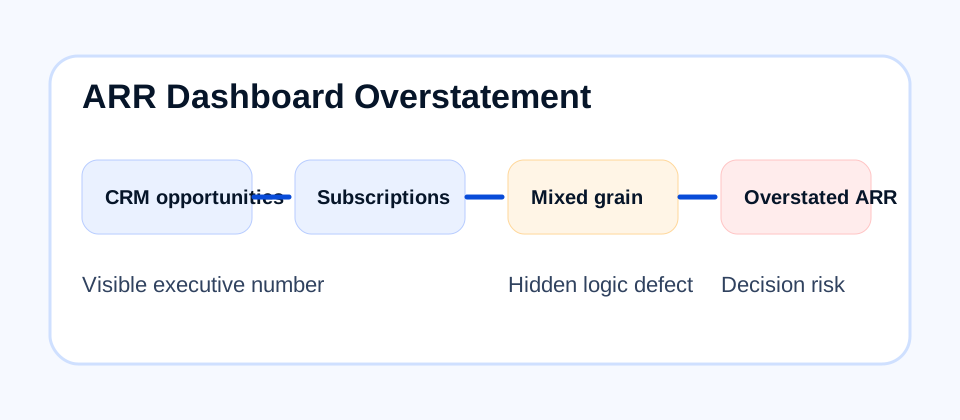
ARR Dashboard Overstatement
Visible claim: Board-facing ARR looked clean and stable.
Hidden defect: The dashboard mixed account grain, subscription grain, opportunity status, and renewal logic. Expansion revenue could be counted at close and again when the renewed subscription became active.
Executive risk: Leadership may overstate recurring revenue, overhire, misread retention, or present a valuation story that cannot survive diligence.
Proof memo 2
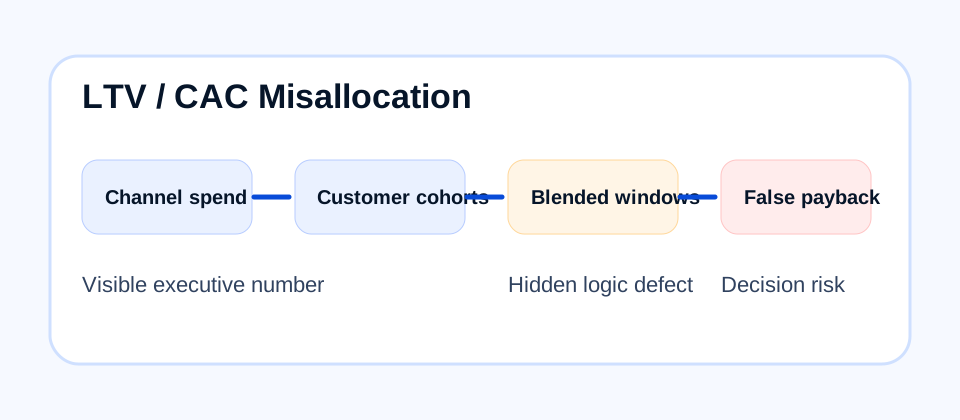
LTV / CAC Misallocation
Visible claim: Acquisition economics appeared attractive by channel.
Hidden defect: Customer cohorts, acquisition cost windows, payback period, retention curves, discounts, and account expansion were blended across incompatible time windows.
Executive risk: Capital can shift toward channels that look efficient only because cost and value are not matched to the same customer, period, and retention behavior.
Proof memo 3
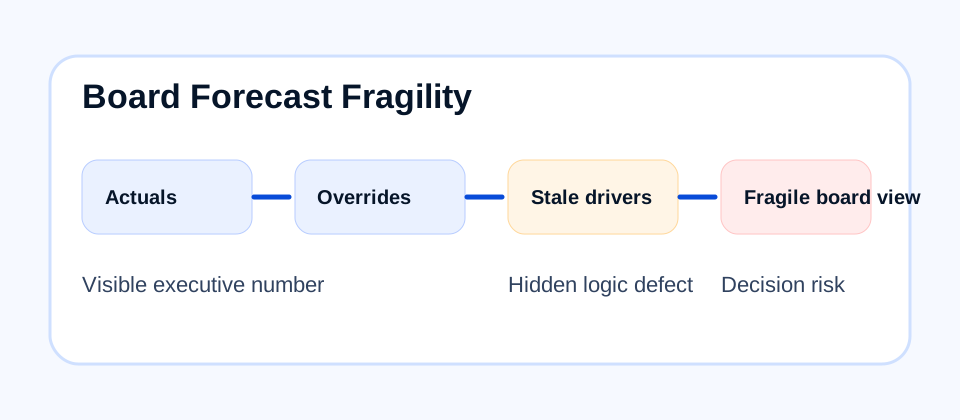
Board Forecast Fragility
Visible claim: The board forecast looked ready for executive presentation.
Hidden defect: The model depended on hidden overrides, stale drivers, weak downside cases, manually pasted actuals, and assumptions that were no longer tied to owned business logic.
Executive risk: A confident board narrative can be built on fragile logic. Hiring, budget, runway, revenue commitments, and investor confidence can all be distorted.
Deliverables
Short enough for executives. Precise enough for operators.
The Ledger is constrained on purpose. It produces evidence, severity, financial framing, and a recommendation without becoming a broad strategy project.
01
20-minute Loom
Walkthrough of the strongest findings, why they matter, and what leadership should do next.
02
5-page risk ledger
Finding, evidence, likely cause, business implication, severity, and recommended action.
03
Severity matrix
Risk scored from 1 to 5, with 5 reserved for board, valuation, acquisition, capital allocation, or major forecast risk.
04
Financial-risk framing
How the defect can distort spend, hiring, valuation, board narrative, operating priorities, or confidence.
05
Scope guardrails
Review and diagnosis only. No implementation, dashboard rebuild, data pipeline work, or unlimited interviews.
06
Next-step recommendation
Cut, keep, rebuild, automate, govern, stop, escalate to Spend Review, or escalate to Analytics QoE.
Public Q1 B2B offers
Only three corporate doors stay public in Q1.
The Ledger is the paid proof wedge. Larger offers stay simple and tied to buyer pain.
- Analytics Debt Ledger: when one number, dashboard, workflow, forecast, or AI output may be unsafe.
- Analytics and AI Spend Rationalization Review: when spend is high and decision quality is still weak.
- Analytics QoE / Live-Deal Diligence: when target metrics, dashboards, forecasts, or architecture affect valuation or post-close plans.
Next step
Bring the artifact. FIP will test the risk.
Use this only when a real executive number is attached to a real decision.